
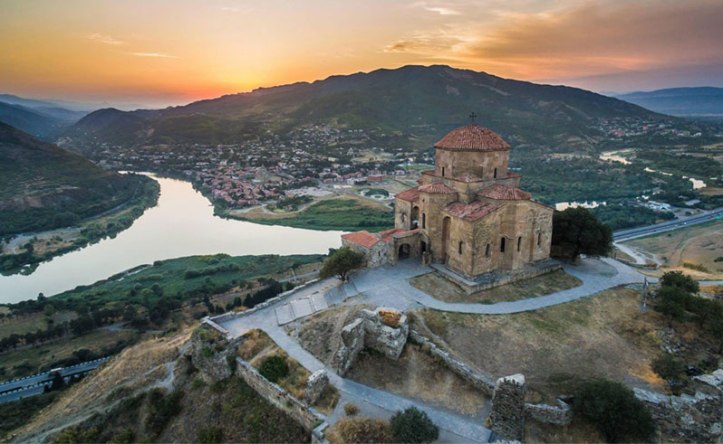
Mtskheta was founded in the 5th century BC. It was capital of the early Georgian Kingdom of Iberia (Kartli) from the 3rd century BC to the 5th century AD. It was a site of early Christian activity, and the location where Christianity was proclaimed the state religion of Kartli in 337.
King Dachi I Ujarmeli (early 6th century AD), who was the successor of Vakhtang I Gorgasali, moved the capital from Mtskheta to the more easily defensible Tbilisi according to the will left by his father. However, Mtskheta continued to serve as the coronation and burial place for most kings of Georgia until the end of the kingdom in the 19th century.
The old city lies at the confluence of the rivers Mtkvari and Aragvi.
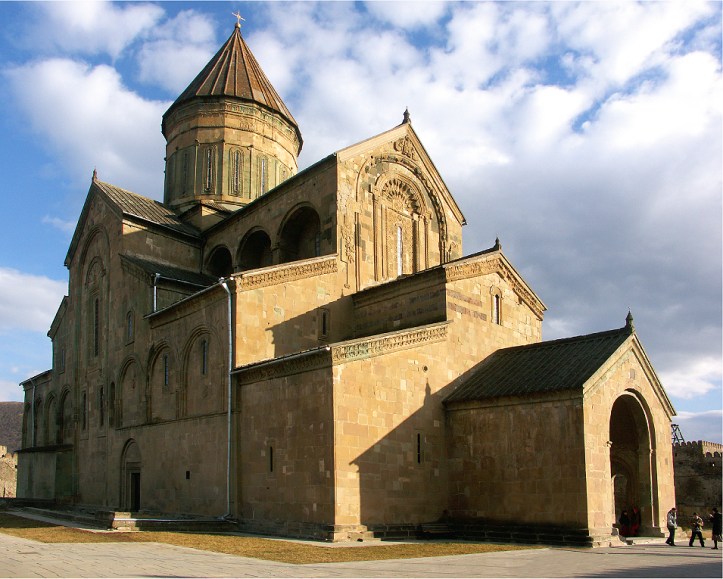 Svetitskhoveli Cathedral
Situated at the confluence of the Aragvi and Mtkvari rivers, the cathedral was built by architect Arsukidze in the early 11th century and is the place where Georgian kings were crowned and buried. The cathedral is one of the most sacred places in Georgia and the place where Christ’s robe is said to be buried.
According to Georgian tradition, a Georgian Jew from Mtskheta named Elias was in Jerusalem when Jesus was crucified. He bought Jesus’ robe from a Roman soldier at Golgotha and brought it back to Georgia. Upon his return to Mtskheta, he was met by his sister Sidonia who upon touching the robe immediately died from the emotions engendered by the holy object. The robe could not be removed from her grasp, so she was buried with it. The place where Sidonia is buried, with Christ’s robe, is preserved in the Cathedral.
Later, from her grave grew an enormous cedar tree. St. Nino ordered the cedar chopped down to build a church. From the cedar tree she had seven columns made for the church foundations. The seventh column, however, had magical properties and rose by itself into the air. After St. Nino prayed the whole night it returned to earth. In Georgian sveti means “pillar” and tskhoveli means “life-giving” or “living”, hence the name of the cathedral.
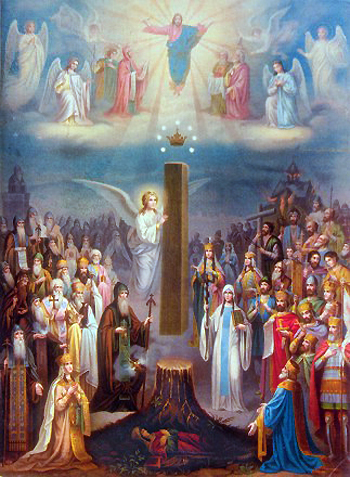
An icon portraying this event can be seen in the cathedral. It depicts Sidonia with an angel lifting the column in heaven.
St. Nino is in the foreground while King Mirian and his wife, Queen Nana, are presented to the right and left.
A small stone church was built inside the Cathedral at the end of the 13th and the beginning of the 14th century.. The church is a symbolic copy of the Chapel of Holy Sepulchre in Jerusalem. It marks Svetitskhoveli as the second most sacred Christian place in the world (after the Church of Jerusalem).
Svetitskhoveli is the second largest church building in Georgia, after the Sameba Cathedral in Tbilisi, and is listed as a UNESCO World Heritage Site along with other historical monuments of Mtskheta.
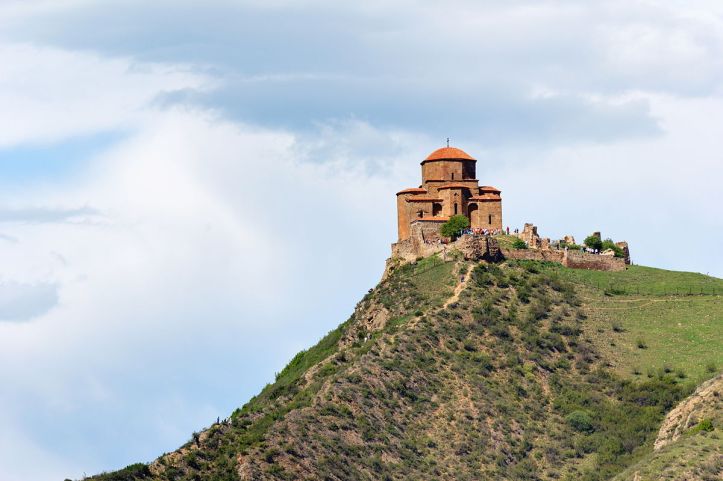
Jvari Monastery
Jvari Monastery stands on the rocky mountaintop at the confluence of the Mtkvari and Aragvi rivers, overlooking the town of Mtskheta, which was formerly the capital of the Kingdom of Iberia.
The Jvari Monastery, or Monastery of the Cross, is one of the oldest in the Caucasus. It is believed to have been built on the spot where St. Nino established the area’s first mission, setting up a cross big enough so that the whole town could see it. The current monastery dates back to around 600 AD, but the original building wasn’t much older. The architecture of the monastery’s church is an almost fortress-like design that borrowed from the Byzantine style and which later served as a prototype for many of the churches and monasteries of the Caucasus.
The importance of Jvari complex increased over time and attracted many pilgrims. In the late Middle Ages, the complex was fortified by a stone wall and gate, remnants of which still survive. During the Soviet period, the church was preserved as a national monument, but access was rendered difficult by tight security at a nearby military base. After the independence of Georgia, the building was restored to active religious use. Jvari was listed together with other monuments of Mtskheta in 1994 as a UNESCO World Heritage Site.
 Best Tours Georgia