
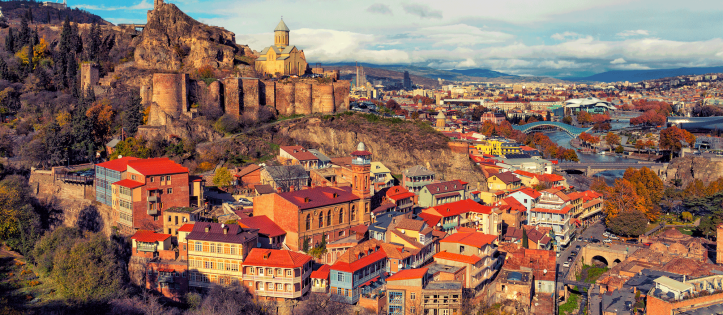
The capital city of Georgia
Tbilisi is the capital and the largest city of Georgia, lying on the banks of the Kura River with a population of approximately 1.5 million people. One widely accepted variant of the legend of Tbilisi’s founding states that King Vakhtang I Gorgasali of Georgia went hunting in the heavily wooded region with a falcon (sometimes the falcon is replaced with either a hawk or other small birds of prey in the legend). The King’s falcon allegedly caught or injured a pheasant during the hunt, after which both birds fell into a nearby hot spring and died from burns. King Vakhtang became so impressed with the hot springs that he decided to cut down the forest and build a city on the location. The name Tbilisi derives from Old Georgian T’bilisi (თბილისი), and further from T’pili (თბილი, “warm””). The name “T’bili” or “T’bilisi” (literally, “warm location”) was therefore given to the city because of the area’s numerous sulphuric hot springs that came out of the ground.
King Dachi I Ujarmeli, who was the successor of Vakhtang I Gorgasali, moved the capital from Mtskheta to Tbilisi according to the will left by his father.
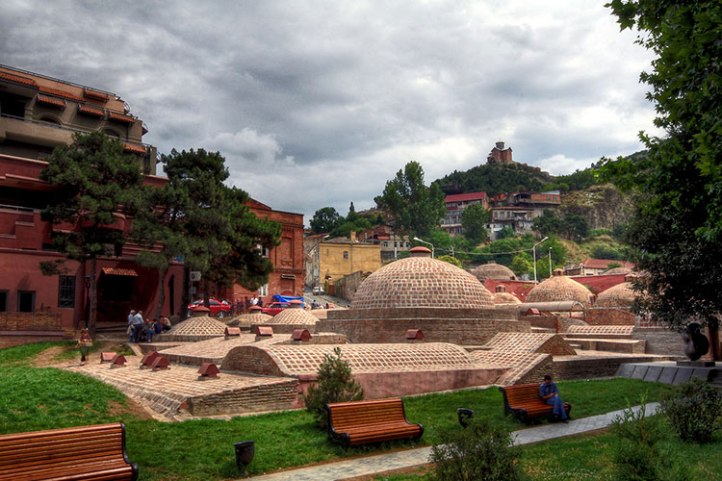
Abanotubani
The Sulfur Bath
There are few sights more representative of Tbilisi than Abanotubani (the bath district). Legend has it that Tbilisi wouldn’t be here without it. In the 5th century, King Vakhtang I Gorgasali of Georgia went hunting in the heavily wooded region with a falcon. The King’s falcon allegedly caught or injured a pheasant during the hunt, after which both birds fell into a nearby hot spring and died from burns. King Vakhtang became so impressed with the hot springs that he decided to cut down the forest and build a city on the location. He named Tbilisi, based on the Georgian word “tbili” or “warm”. Today, a monument to Gorgasali overlooks Abanotubani from across the Mtkvari River, and a small statue of falcon can be found among the bath.
Documentation of the hot springs goes back to the 10th century when an Arab geographer, Abu Dulaf noted in his diary that “the water in Tbilisi boils without fire”, but recent archaeological excavations indicate an ever earlier settlement – Roman style baths with plumbing that date to the 1st century.
The water in Tbilisi naturally comes from the earth with a temperature ranging between 75 and 107 degrees Fahrenheit.
By the 13th century, there were 63 bath in the area, according to Tbilisi historian Tsira Elisashvili. In the early 19th century, Russian visitors described 10, about the same number that exist today. Famous visitors were Dumas and Pushkin.
Tradition known as the “bride check”. In which potential brides met their future mother-in-laws at the bath, so the girls body could be examined for defects.
About health improvement – Of course, one bath visit hasn’t any noticeable effect. But due to the fact that some of the baths transformed into spa you can get a health treatment. Recommend for people suffering from back pain, metabolism problems and obesity.
It’s a walking tour in Old Tbilisi, with expirienced guide, which includes detailed explanation of historic important and nice places.
 Best Tours Georgia