
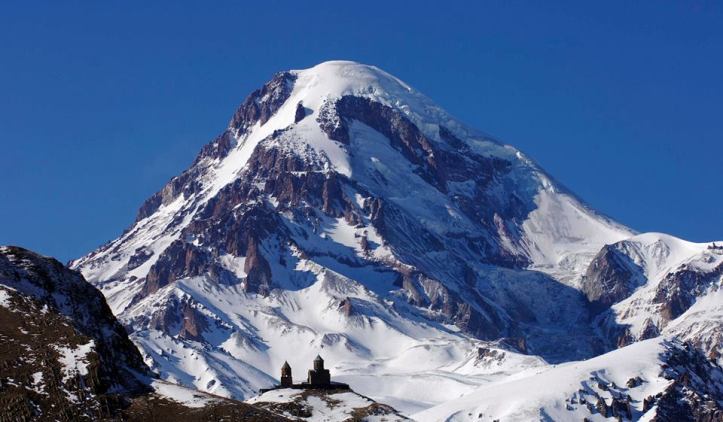
Kazbegi
Stepantsminda, commonly known as Kazbegi, is a small town in the north-east Georgia, close to the Russian border. It is one of the must see destinations in Georgia, mostly due to amazing hiking routes and stunning nature.
The town is located along the banks of the Terek River, 157 kilometers (98 mi) to the north of Tbilisi at an elevation of 1,740 meters (5,710 feet) above sea level. Stepantsminda’s climate is moderately humid with relatively dry, cold winters and long and cool summers. The average annual temperature is 4.9 degrees Celsius. January is the coldest month with an average temperature of -5.2 degrees Celsius while July is the warmest month with an average temperature of 14.4 degrees Celsius. The absolute minimum recorded temperature is -34 degrees Celsius and the absolute maximum is 32 degrees Celsius. Stepantsminda’s average annual precipitation is 790 mm. (31.1 inches). The town is dominated by large mountains on all sides. The most notable mountain of the region, Mount Kazbek, lies immediately to the west of town. The second most prominent peak, Mt. Shani, rises to an elevation of 4,451 meters (14,600 feet) above sea level, 9 kilometers to the east of Stepantsminda. The town is located 10 kilometers to the south of the famous Darial Gorge.
According to tradition, Stepantsminda, literally “Saint Stephan”, was named so after a Georgian Orthodox monk Stephan, who constructed a hermitage at this location on what later became the Georgian Military Highway. It came under the control of a local feudal magnate, the Chopikashvili clan, who were in charge of collecting tolls on travelers in the area in the late 18th century. After the expansion of the Russian Empire into the Kingdom of Georgia in the early 19th century, the people of the region revolted against Russian rule. However, the local lord Gabriel Chopikashvili, son of Kazi-Beg, remained steadfast in his loyalty to Russia and helped to suppress the revolt. In return, he was promoted to officer in the Russian Army. He adopted the surname Kazbegi, and the village under his control was also frequently referred to as “Kazbegi”. The name was officially changed to Kazbegi already under the Soviet rule in 1925. Gabriel Chopikashvili-Kazbegi’s grandson was the famed Georgian writer Alexander Kazbegi, who was born in this town. In 2006, the town reverted to its original name of Stepantsiminda.

Ananuri
Ananuri was a castle and seat of the eristavis (Dukes) of Aragvi, a feudal dynasty which ruled the area from the 13th century. The castle was the scene of numerous battles. In 1739, Ananuri was attacked by forces from a rival duchy, commanded by Shanshe of Ksani and was set on fire. The Aragvi clan was massacred. However, four years later, the local peasants revolted against rule by the Shamshe, killing the usurpers and inviting King Teimuraz II to rule directly over them. However, in 1746, King Teimuraz was forced to suppress another peasant uprising, with the help of King Erekle II of Kakheti. The fortress remained in use until the beginning of the 19th century.
The fortifications consist of two castles joined by a crenellated curtain wall. The upper fortification with a large square tower, known as Sheupovari, is well preserved and is the location of the last defense of the Aragvi against the Shamshe. The lower fortification, with a round tower, is mostly in ruins.
Within the complex, amongst other buildings, are two churches. The older Church of the Virgin, which abuts a tall square tower, has the graves of some of the Dukes of Aragvi. It dates from the first half of the 17th century, and was built of brick. The interior is no longer decorated, but of interest is a stone baldaquin erected by the widow of the Duke Edisheri, who died in 1674. The larger Church of the Assumption (Ghvtismshobeli), built in 1689 for the son of Duke Bardzem. It is a central dome style structure with richly decorated facades, including a carved north entrance and a carved grapevine cross on the south facade. It also contains the remains of a number of frescoes, most of which were destroyed by the fire in the 18th century.
In 2007, the complex has been on the tentative list for inclusion into the UNESCO World Heritage Site program
 Best Tours Georgia