
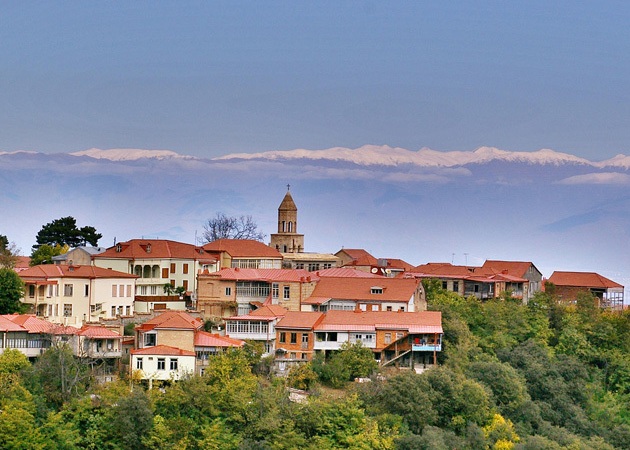
Signagi is a town in Georgia’s easternmost region of Kakheti and the administrative center of the Signagi Municipality. Although it is one of Georgia’s smallest towns, Signagi serves as a popular tourist destination due to its location at the heart of Georgia’s wine-growing regions, as well as its picturesque landscapes, pastel houses and narrow, cobblestone streets. Located on a steep hill, Signagi overlooks the vast Alazani Valley, with the Caucasus Mountains visible at a distance.
Signagi is located in the Kakheti region of Georgia, settled since the Paleolithic period. Signagi as a settlement is first recorded in the early 18th century. In 1762, King Heraclius II of Georgia sponsored the construction of the town and erected a fortress to defend the area from marauding attacks by Dagestan tribesmen.
The town quickly rose in its size and population and became an agricultural center under the Soviet Union. The severe economic crisis in post-Soviet Georgia heavily affected the town, but a major reconstruction project recently launched by the Government of Georgia and co-funded by several international organizations intends to address an increasing tourist interest and modernize infrastructure.
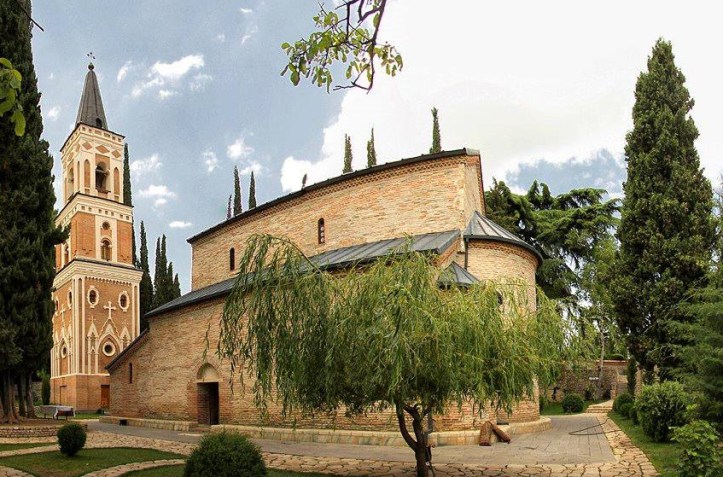
Bodbe – St. Nino Monastery
The Monastery of St. Nino at Bodbe is a Georgian Orthodox monastic complex and the seat of the Bishops of Bodbe located 2 km from the town of Sighnaghi, Kakheti, Georgia. Originally built in the 9th century, it has been significantly remodeled, especially in the 17th century. The monastery now functions as a nunnery and is one of the major pilgrimage sites in Georgia, due to its association with St. Nino, the 4th-century female evangelist of Georgians, whose relics are shrined there.
According to Georgian tradition, St. Nino, having witnessed the conversion of Georgians to the Christian faith, withdrew to the Bodbe gorge, in Kakheti, where she died c. 338-340. At the behest of King Mirian III (r. 284-361), a small monastery was built at the place where Nino was buried. The monastery gained particular prominence in the late Middle Ages. It was particularly favored by the kings of Kakheti who made choice of the monastery as the place of their coronation. Pillaged by the troops of Shah Abbas I of Persia in 1615, the Bodbe monastery was restored by King Teimuraz I of Kakheti (r. 1605-1648). With the revival of monastic life in Bodbe, a theological school was opened. The monastery also operated one of the largest depositories of religious books in Georgia and was home to several religious writers and scribes.
After the annexation of Georgia by the Russian Empire (1801), the Bodbe monastery continued to flourish under Metropolitan John Maqashvili and enjoyed the patronage of Tsar Alexander I of Russia. In 1823, the monastery was repaired and adorned with murals. Upon John’s death in 1837, the Russian Orthodox exarchate active in Georgia since 1810 abolished the convent and converted it into a parish church. In the following decades, the monastery went into disrepair, but, in the 1860s, Archimandrite Macarius (Batatashvili) began to restore the monastery and established a chanting school. The chapel housing St. Nino’s relics were refurbished by Mikhail Sabinin in the 1880s. In 1889, Bodbe was visited by Tsar Alexander III of Russia who decreed to open a nunnery there. The resurrected convent also operated a school where needlework and painting was taught. In 1924, the Soviet government closed down the monastery and converted it into a hospital. In 1991, after the dissolution of the Soviet Union, the Bodbe monastery was resumed as a convent. Restoration works were carried out between 1990 and 2000 and resumed in 2003.
Down the hill from the monastery church, the bell-tower lies the Spring of Saint Nino, where pilgrims – or visitors – are meant to plunge themselves three times into the frigid water. They say the spring has curative powers and absolves one of sins.
 Best Tours Georgia