
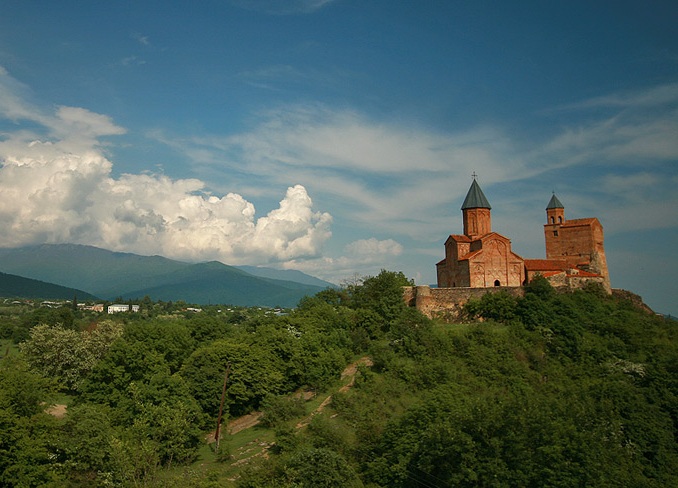
Kakheti is a region formed in the 1990s in eastern Georgia from the historical province of Kakheti and the small, mountainous province of Tusheti. Telavi is its capital. Kakheti is bordered by the Russian Federation to the Northeast, Azerbaijan to the Southeast, and the Georgian regions of Mtskheta-Mtianeti and Kvemo Kartli to the west.
Kakheti was an independent feudal principality from the end of the eighth century. It was incorporated into the united Georgian Kingdom at the beginning of the eleventh century, but for less than a decade. Only in the beginning of the twelfth century did Georgian King David the Builder (1089–1125) incorporate Kakheti into his Kingdom successfully.
After the disintegration of the Georgian Kingdom, Kakheti became an independent Kingdom in the 1460s. From the early 16th century till the early 19th century, Kakheti and its neighboring Kartli came under intermittent Iranian rule. In 1616, Shah Abbas deported hundreds of thousands of the ethnic Kakheti Georgian population to Iran and destroyed the region during his punitive campaign against Teimuraz I, his formerly most loyal subject. During all these centuries the region was an integral part of Iran and it supplied many notable generals, administrators, women and many hundred of thousands of peasants for the Iranian overlords. In 1762, the Kakhetian Kingdom was united with the neighboring Georgian Kingdom of Kartli into the Kingdom of Kartli-Kakheti under King Erekle II.
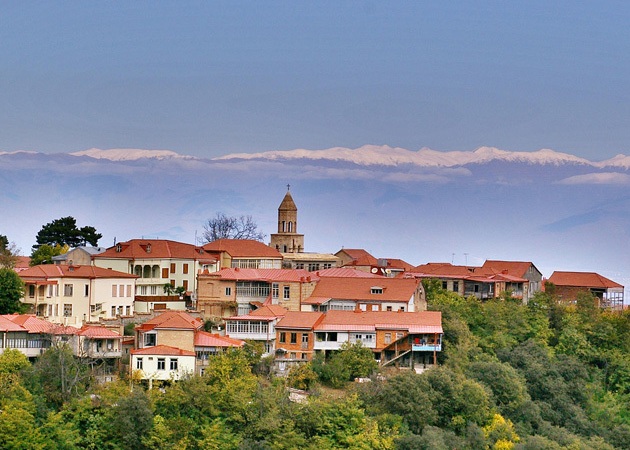
Signagi
Signagi is a town in Georgia’s easternmost region of Kakheti and the administrative center of the Signagi Municipality. Although it is one of Georgia’s smallest towns, Signagi serves as a popular tourist destination due to its location at the heart of Georgia’s wine-growing regions, as well as its picturesque landscapes, pastel houses and narrow, cobblestone streets. Located on a steep hill, Signagi overlooks the vast Alazani Valley, with the Caucasus Mountains visible at a distance.
Signagi is located in the Kakheti region of Georgia, settled since the Paleolithic period. Signagi as a settlement is first recorded in the early 18th century. In 1762, King Heraclius II of Georgia sponsored the construction of the town and erected a fortress to defend the area from marauding attacks by Dagestan tribesmen.
The town quickly rose in its size and population and became an agricultural center under the Soviet Union. The severe economic crisis in post-Soviet Georgia heavily affected the town, but a major reconstruction project recently launched by the Government of Georgia and co-funded by several international organizations intends to address an increasing tourist interest and modernize infrastructure.
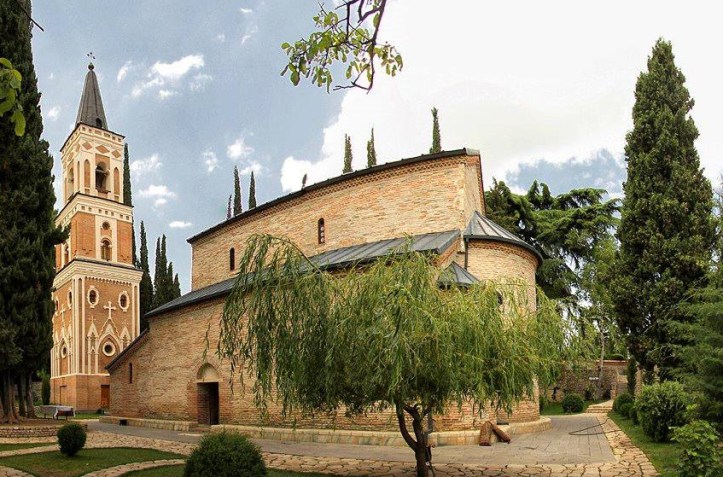
Bodbe – St. Nino Monastery
The Monastery of St. Nino at Bodbe is a Georgian Orthodox monastic complex and the seat of the Bishops of Bodbe located 2 km from the town of Sighnaghi, Kakheti, Georgia. Originally built in the 9th century, it has been significantly remodeled, especially in the 17th century. The monastery now functions as a nunnery and is one of the major pilgrimage sites in Georgia, due to its association with St. Nino, the 4th-century female evangelist of Georgians, whose relics are shrined there.
According to Georgian tradition, St. Nino, having witnessed the conversion of Georgians to the Christian faith, withdrew to the Bodbe gorge, in Kakheti, where she died c. 338-340. At the behest of King Mirian III (r. 284-361), a small monastery was built at the place where Nino was buried. The monastery gained particular prominence in the late Middle Ages. It was particularly favored by the kings of Kakheti who made choice of the monastery as the place of their coronation. Pillaged by the troops of Shah Abbas I of Persia in 1615, the Bodbe monastery was restored by King Teimuraz I of Kakheti (r. 1605-1648). With the revival of monastic life in Bodbe, a theological school was opened. The monastery also operated one of the largest depositories of religious books in Georgia and was home to several religious writers and scribes.
After the annexation of Georgia by the Russian Empire (1801), the Bodbe monastery continued to flourish under Metropolitan John Maqashvili and enjoyed the patronage of Tsar Alexander I of Russia. In 1823, the monastery was repaired and adorned with murals. Upon John’s death in 1837, the Russian Orthodox exarchate active in Georgia since 1810 abolished the convent and converted it into a parish church. In the following decades, the monastery went into disrepair, but, in the 1860s, Archimandrite Macarius (Batatashvili) began to restore the monastery and established a chanting school. The chapel housing St. Nino’s relics were refurbished by Mikhail Sabinin in the 1880s. In 1889, Bodbe was visited by Tsar Alexander III of Russia who decreed to open a nunnery there. The resurrected convent also operated a school where needlework and painting was taught. In 1924, the Soviet government closed down the monastery and converted it into a hospital. In 1991, after the dissolution of the Soviet Union, the Bodbe monastery was resumed as a convent. Restoration works were carried out between 1990 and 2000 and resumed in 2003.
Down the hill from the monastery church, the bell-tower lies the Spring of Saint Nino, where pilgrims – or visitors – are meant to plunge themselves three times into the frigid water. They say the spring has curative powers and absolves one of sins.
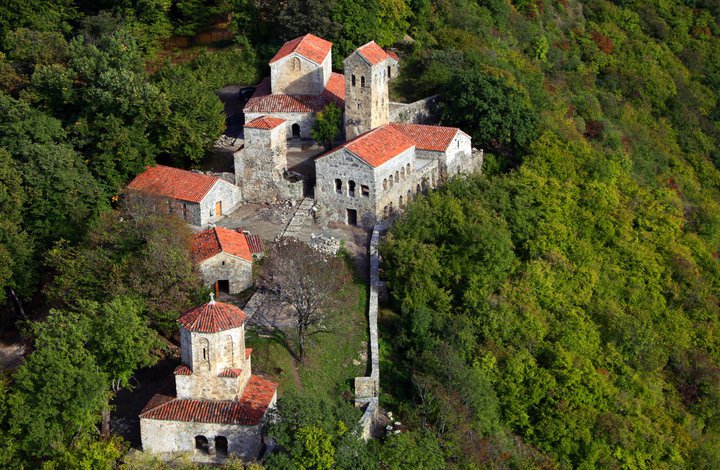
Nekresi
Nekresi is a historic town in Kakheti, Georgia, in modern day Kvareli Municipality, near the village of Shilda.
Nekresi Monastery is one of the largest monastery complexes in the Kakheti region of Georgia and was founded by St. Abibos Nekreseli, one of the famous thirteen Syrian fathers.
The monastery remembers numerous Muslim invasions. The legend tells us about one of them: Nekresi was attacked by Muslims and the defenders of the monastery let pigs out of the monastery. When Muslims soldiers saw pigs on their way, they ceased hostilities and left the monastery in peace. In commemoration of this rescue the pig was announced as Nekresi protector and up to now the Nekresi st. Virgin temple is the only church in Georgia to which the pig can be sacrificed.
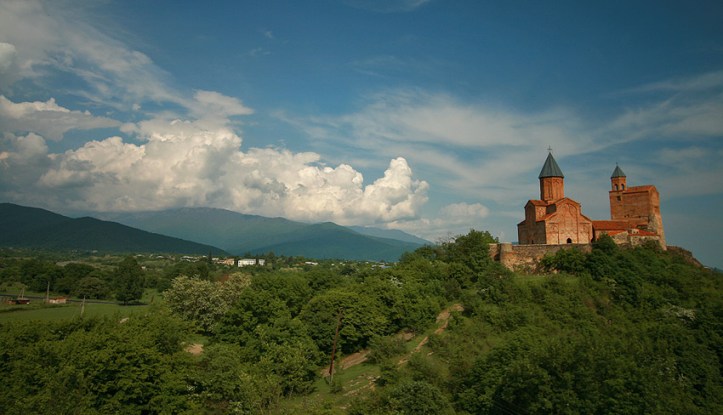
Gremi
Gremi is a 16th-century architectural monument – the royal citadel and the Church of the Archangels – in Kakheti, Georgia. The complex is what has survived from the once flourishing town of Gremi and is located southwest of the present-day village of the same name in the Kvareli district, 175 kilometers east of Tbilisi, capital of Georgia.
Gremi was the capital of the Kingdom of Kakheti in the 16th and 17th centuries. Founded by Levan of Kakheti, it functioned as a lively trading town on the Silk Road and royal residence until being razed to the ground by the armies of Shah Abbas I of Persia in 1615. The town never regained its past prosperity and the kings of Kakheti transferred their capital to Telavi in the mid-17th century. There was big Armenian population. The Russian diplomat Fedor Volkonsky, who was here in the 17th century, said: “Armenians have own church and market behind one was other church”. He also said about 10 Armenian churches near the palace of king.
The town appears to have occupied the area of approximately 40 hectares and to have been composed of three principal parts – the Archangels’ Church complex, the royal residence and the commercial neighborhood. Systematic archaeological studies of the area guided by A. Mamulashvili and P. Zak’araia were carried out in 1939-1949 and 1963-1967, respectively. Since 2007, the monuments of Gremi have been proposed for inclusion into the UNESCO World Heritage Sites.
The Archangels’ Church complex is located on a hill and composed of the Church of the Archangels Michael and Gabriel itself, a three-story castle, a bell tower and a wine cellar (marani). It is encircled by a wall secured by embrasures, turrets and towers. Remains of the secret tunnel leading to the Ints’obi River have also survived.
The Church of the Archangels was constructed at the behest of King Levan of Kakheti (r. 1520–1574) in 1565 and frescoed by 1577. It is a cruciform domed church built chiefly of stone. Its design marries traditional Georgian masonry with a local interpretation of the contemporary Iranian architectural taste.[2] The building has three entrances, one facing west, one facing to the south, and the third facing to the north. The interior is crowned with a dome supported by the corners of the sanctuary and two basic piers. The façade is divided into three arched sections. The dome sits on an arcaded drum which is punctured by eight windows.
The bell-tower also houses a museum where several archaeological artifacts and the 16th-century cannon are displayed. The walls are adorned with a series of portraits of the kings of Kakheti by the modern Georgian painter Levan Chogoshvili (1985).
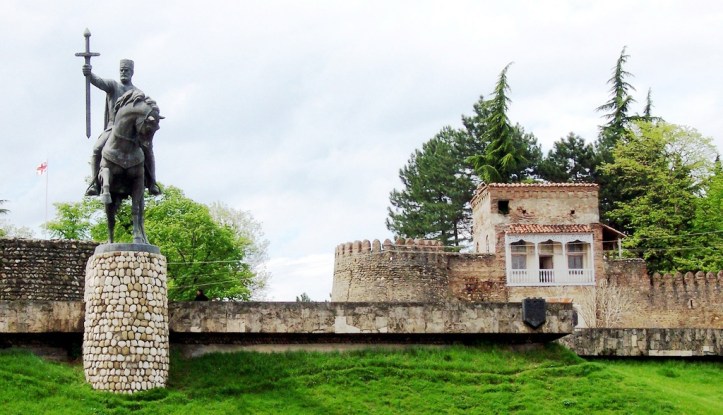
Telavi
Telavi is the main city and administrative center of Georgia’s eastern province of Kakheti. Its population consists of some 21,800 inhabitants. The city is located on foot-hills of Tsiv-Gombori Range at 500–800 meters above the sea level.
The first archaeological findings from Telavi date back to the Bronze Age. One of the earliest surviving accounts of Telavi is from the 2nd century AD, by Greek geographer Claudius Ptolemaeus, who mentions the name Teleda (a reference to Telavi). Telavi began to transform into a fairly important and large political and administrative center in the 8th century AD. Interesting information on Telavi is provided in the records by an Arab geographer, Al-Muqaddasi of the 10th century, who mentions Telavi along with such important cities of that time’s Caucasus as Tbilisi, Shamkhor, Ganja, Shemakha and Shirvan. Speaking about the population of Telavi, Al-Muqaddasi points out that for the most part it consisted of Christians.
From the 10th until the 12th century AD, Telavi served as the capital of the Kingdom of Kakheti and later Kingdom of Kakhet-Hereti. During the so-called Golden Era of the Georgian State (12th-13th centuries), Telavi turned into one of the most important political and economic centers of the Georgian State. After the disintegration of the united Georgian Kingdom in the 15th century, the role of Telavi started to decline and the city eventually became an ordinary town of trade and crafts. Telavi re-gained its political importance in the 17th century when it became a capital of the kingdom of Kakheti. By 1762, it turned into the second capital (after Tbilisi) of the united Eastern Georgian Kingdom of Kartl-Kakheti. The reign of King Erekle II, who was born and died in this city, was a special epoch in the history of Telavi. During this period (1744–1798) it grew into a strategic and cultural centre. Erakle II established there a theological seminary and founded a theatre. Erekle II’s reforms touched upon all aspects of life in the country. They changed fundamentally the political, economical and cultural orientation of Kartli-Kakheti and, subsequently of the whole Georgia. His name became a symbol of freedom and national independence of the Georgian people. Erakle II is still called affectionately “Patara Kakhi” (Little Kakhetian), and his heroic deeds are described in folk literature.

Old Shuamta
(Dzveli Shuamta)
Old Shuamta (Dzveli Shuamta) Monastery is located in a small clearing in the middle of a deciduous forest on Tsivgombori Mountain near the city of Telavi in Kakheti region. The Monastery got its name because of its location – “Shuamta’’ means ‘among the mountains’.
The complex comprises three early churches: Among them the oldest one is Basilica which dates the 5th century and is considered as one of the most significant and trust-worthy. The complex also includes the 7th century church of a type close to the Mtskheta Jvari Church, but of a small size. The third one is Minor Domed church. Dates by 7th century. All of them were built by cobble stones, the corners were faced with hewn stones. In the 16th century the Monastry of the Dzveli (Old) Shuamta was abandoned. Despite the fact that it is not active nowadays, it still welcomes a lot of visitors.

New Shuamta
(Akhali Shuamta)
Tinatin, the wife of the king of kakhs Levan-II (1520-1574) and daughter of Lord Gurieli, founded the Akhali (New) Shuamta monastery. There is a legend related to the construction of the temple: as a child, Lord Gurieli’s daughter Tinatin once dreamed that she would marry the prince in whose farmstead she would find a white cornel tree, where she would have to build a church in honour of the Holy Virgin. Indeed, Tinatin married Kakhetian king Levan-II and on their way back from Guria to Gremi with the icon of the Holy Virgin of Khakhuli, they stopped exactly at this place and stayed overnight, placing the icon on the cornel tree which she had dreamed about before. In the morning they saw the miracle – the icon was attached to the tree, a clear sign to build the church. So Queen Tinatin’s dream came true. She built a church and monastery of brick for a community of nuns. Later she herself joined this convent and is buried in the church.
The church is based on a cruciform plan and is painted inside. The inner walls were decorated with mural paintings. Portraits of Donors and some other frescos have preserved. At the end of the XVI century the Queen’s daughter, the nun Thekla, attached to the main church a small chapel of Archangels and gave donations for it. Later, King Teimuraz-I in 1637 issued a deed by which he donated to the monastery customs duties from the merchant caravans which passed along the Gombori way. Finally, the church was renewed by king Erekle-II.
In the XIX century New Shuamta Monastery shared the hardships of the country like the other spiritual centres of Kakheti. Monastic life was gradually diminished. Its revival is connected with the name of Kirion, Bishop of Alaverdi, later the Catholicos-Patriarch of Georgia. By his work the Monastery was renewed in 1899. But this period turned out to be short – during the Soviet regime the Monastery was closed and an orphanage was placed here
Monastic life in New Shuamta Monastery was restored again in 1990.
 Best Tours Georgia